
Monroe County Active Warrants Directory
Monroe County has no dedicated "most wanted" wall. The sheriff's site takes a different route. What the Monroe County Sheriff's Office publishes is its MCSO Active Warrants directory, a working tool rather than a publicity gallery. Pages run A through Z by last-name initial. Each page carries an "As of" timestamp marking when the sheriff's data was last presented. No fixed refresh schedule is promised. Treat what you see as a snapshot, not a live feed.
Some entries include a photo link. Others show nothing but text. That gap means nothing, since a missing picture doesn't weaken the warrant record itself. The directory is dynamic, so totals shift from one visit to the next. No stable count holds. If someone disappears from a page, that alone doesn't tell you they were booked into jail.
The official MCSO directory lays out its alphabetical controls, timestamp, safety warning, and tip paths right on the page, so a visitor can navigate it without any reproduced wanted-person photo collection.
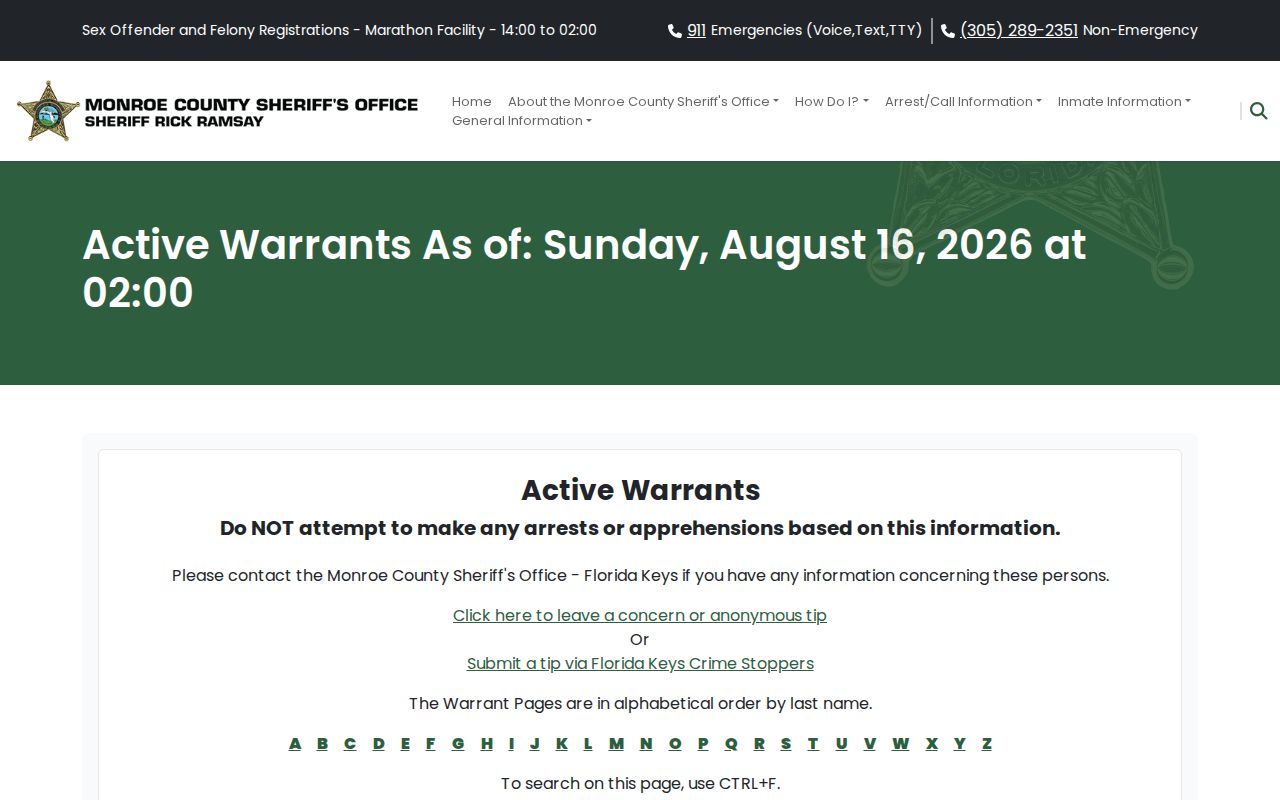
Note the sheriff's own wording here. The site calls this an Active Warrants directory, plain and simple. It is not a ranked or hand-picked fugitive list, and reading it that way only leads to confusion.
Monroe County Warrant Listing Fields
Each MCSO listing pairs identity details with warrant and bond data. The point of those fields is telling people apart. Similar names are common. One caution: addresses and physical descriptions can lag behind reality. Photo links are optional too. A blank image slot should stay blank rather than being filled with a picture from some unrelated source.
| Field | What the official listing may show |
|---|---|
| Name | The name tied to the MCSO warrant entry |
| Photograph | A “Click to see Photo” link when an image is available |
| Birth and age data | Date of birth and stated age |
| Physical description | Race, sex, height, weight, hair color, and eye color |
| Address | An address associated with the record, not proof of current location |
| Alleged charge | Charge count, class, statute, and label recorded for the warrant |
| Warrant identifier | The MCSO warrant or arrest identifier used to track the record |
| Issue date and bond | The stated warrant date and any bond information shown |
Read the full entry, not just the name. Birth date, physical traits, and the MCSO identifier all cut down on mistaken identity. A strong match still only means the sheriff published the warrant at the stated time. Confirm anything that matters with officials.
Note: A warrant directory entry is neither a conviction nor proof that the named person remains at large after the page timestamp.
Using Monroe County Active Warrants
Staying on the sheriff's site is the safest approach. Treating each entry as time-sensitive is the smartest habit. Alphabetical pages shine when you already know the last name. When identity or current status truly matters, though, no page replaces a direct answer from MCSO, the court, or a lawyer.
- Open the official Active Warrants directory and note the visible “As of” timestamp before reading an entry.
- Choose the letter matching the person’s last name, then compare the full name and identifying descriptors. Do not rely on a photograph alone.
- Read the warrant identifier, issue date, alleged charge, and bond fields as presented. Do not turn an charge into a statement of guilt.
- If information about the person’s location is known, stop browsing and use the MCSO concern form or the linked Crime Stoppers route. Do not approach.
- To see whether an arrest followed, use the official county booking and custody paths summarized on the Monroe County booking hub.
- Use the Monroe Clerk docket for later court events and disposition rather than relying on an old warrant image or repost.
One listing can look like several different products at once. They answer different questions, though. Current Arrests covers bookings by date. Current Inmates deals with who is in county jail right now. Arrest Search handles history. A warrant entry alone settles none of those custody questions.
Checking a Monroe County Warrant
An alphabetical page is easy to browse. Verifying one specific warrant takes more care. Start with MCSO. If a related criminal case is public, you can trace it through the Monroe County Clerk record next. That system lets you search by case type, full name, case number, or a filing-date range, all within its public-access limits. One caution: a broad name query can bury you in results. It may even hand you the wrong person.
- Search the MCSO Active Warrants letter page using the subject’s last-name initial and record the directory timestamp.
- Compare the name with the date of birth, description, warrant identifier, and issue date shown. Stop if key identity facts do not match.
- Search the Monroe Clerk court-record criteria with a case number when available. Otherwise use a tightly bounded full-name and date search.
- When the public pages do not resolve the question, contact MCSO at its verified non-emergency line or submit a focused request for the existing warrant record through the sheriff’s records portal.
- A person who believes a warrant applies to them should contact a lawyer, the appropriate court, or MCSO to arrange a safe, lawful resolution. Do not rely on online absence or delay.
The Clerk's public-search rules deserve attention. Sealed, expunged, confidential, juvenile, and court-restricted matters may simply not show up. The system itself warns that an empty result doesn't mean no case exists. When in doubt, go straight to an official response.
Monroe County Warrant Types
The language in a warrant record explains why a court or agency wants someone in custody. That's all it explains. For any single entry, let the directory's charge, statute, issue-date, and bond fields drive the reading. Court documents can add procedural context where it exists.
| Record type | Practical meaning for a check |
|---|---|
| Arrest warrant | An order authorizing arrest based on an alleged offense; verify the exact charge and identifier in MCSO records |
| Bench warrant or capias | A court-issued custody command often tied to a case event; consult the Clerk docket and court for current status |
| FDC escape entry | A separate state-corrections record for an escape with an outstanding warrant, not a Monroe County booking list |
| FDC absconder entry | A state-supervision record for a person no longer reporting as required, distinct from the MCSO county directory |
Agency lines matter here. The Florida Department of Corrections runs its own escape and absconder searches covering state-corrections populations. Those records say nothing about a fresh Monroe County booking or current county jail custody. Always check status and agency on the source itself.
Reporting Monroe County Warrant Tips
The MCSO directory links straight to the sheriff's concern route or anonymous-tip option, plus Florida Keys Crime Stoppers. Details shift over time. Tip phone numbers, anonymity terms, and reward wording can all change, so rely on what the official destination shows when you actually submit. Assume no number or payment promise in advance.
Administration Headquarters
5525 College Road
Key West, FL 33040
Headquarters: 305-292-7000
Non-emergency voice/TTY: 305-289-2351
Online: MCSO concern and tip form
Call or text 911 for emergencies and immediate threats. For anything less urgent, use the non-emergency or online route. Give facts, not guesses: the name as listed, the warrant identifier if you have it, and what you saw, where, and when. Then stop. Don't play detective beyond that.
Note: Crime Stoppers terms can change, so verify anonymity and reward language on its linked official tip page before submitting information.
Monroe County Warrants and Court Records
Start with the sheriff's Active Warrants directory. It shows who is wanted now. The list stops at the outstanding-warrant stage, though. For what a case actually produced, use the Monroe Clerk docket. Filed counts, hearing dates, bond actions, dismissals, pleas, sentences, and closures appear there whenever they are public. On final court status, the Clerk beats the warrant list every time.
Depth matters here. Docket entries reach back to about 1990, per the Clerk. Case-document images mostly start in 2007. Search results cap at 500, so a case number works far better than a surname sweep. Sealed, expunged, juvenile, and other confidential matters stay off-limits to public users. Keep those limits in mind. An online miss does not prove a warrant is absent.
The official Monroe Clerk search criteria page lists the supported fields and the access cautions worth reading before a warrant check.
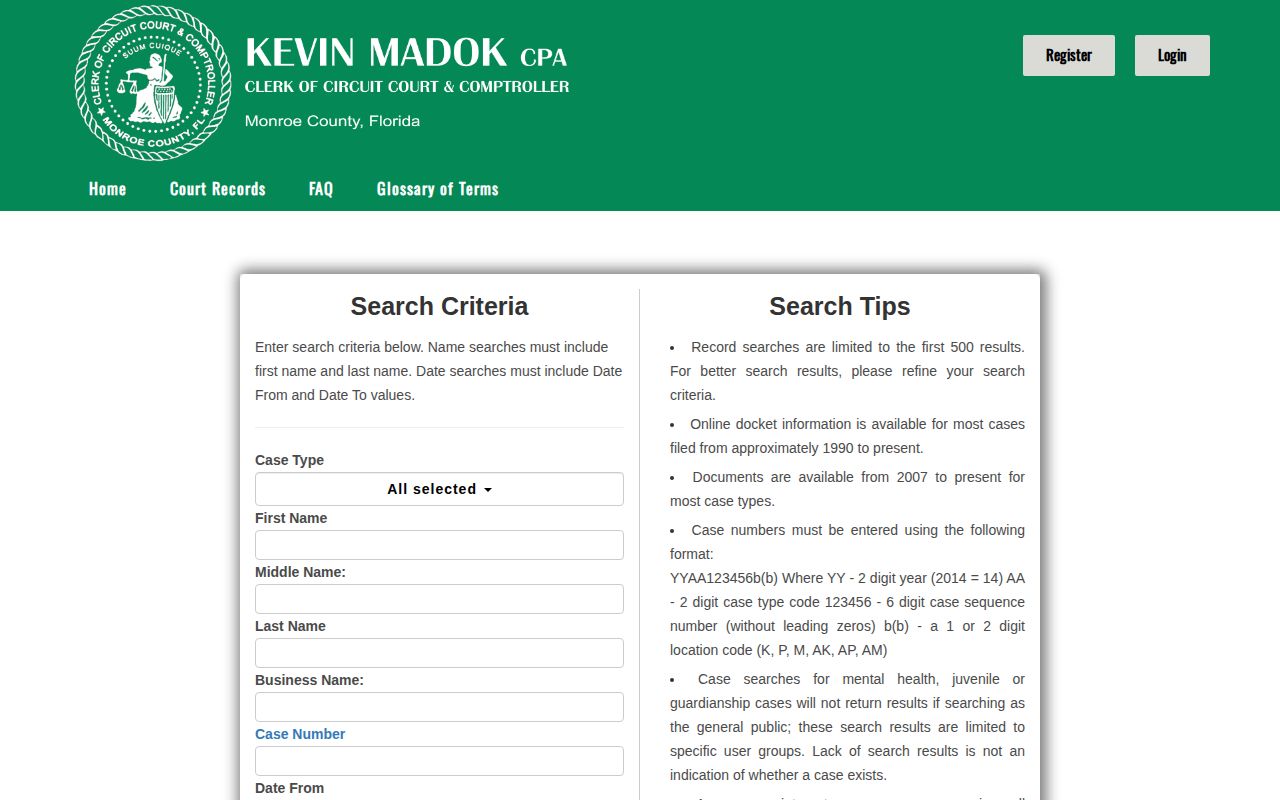
The search form itself makes the case. A case number or a tight name-and-date query will get you clean results where an unbounded search on a common name will not.