
Monroe County Crime News Sources
Two agencies publish their own Monroe County crime news. The Sheriff's Office maintains a Current Weekly Rap Up, plus agency announcements and official social feeds. The Key West Police Department posts selected news releases too. Some of those touch on arrests or search warrants. Neither stream aims to cover every booking. Gaps are normal, not suspicious.
The county's data tools answer narrower questions. Current Arrests lists bookings by date. Current Inmates shows who sits in county custody right now. Arrest Search reaches older named arrest records. The seven-day service-call log tracks incident-level activity and can flag an "ARREST" disposition, though it names no one and shows no photo. Treat these as distinct tools rather than interchangeable blotters.
Want to know how a Monroe County case ended? Check the official court docket rather than relying on a news story or a booking image.
Monroe County Weekly Arrest Reports
The Current Weekly Rap Up sits in MCSO's navigation beside its social accounts. Think of it as agency news. A weekly summary covers whatever MCSO deems newsworthy, whether an investigation, a public-safety warning, an arrest, or an agency event. Plenty of people booked that same week never appear. The app and social channels share that same ceiling: fast, first-party notices with no evidence they reproduce every arrest card or booking photo.
KWPD plays a similar selective role for Key West. It publishes arrest and search-warrant news. No complete city arrest log surfaced, though. Marathon and Islamorada lean on MCSO as their contract police agency, so the sheriff's news may still cover those cases. Silence in an editorial feed proves nothing either way. For actual bookings, use Current Arrests. For present custody, use Current Inmates.
Active Calls and the seven-day service-call log are data products, not stories. The seven-day table lists an incident number, time, general location, complaint, and disposition. An "ARREST" entry can confirm something happened. It names no arrestee and shows no picture. Matching that event to a named booking still takes the arrest search tools or a records request. The key to reading Monroe County crime coverage well is keeping agency news, incident data, booking data, and court outcomes separate.
Monroe County News Outlet Map
Local outlets move at different speeds with different priorities. Florida Keys Weekly holds the strongest verified, actively updated crime category. KeysNews keeps a dedicated crime section, though access limits made its posting rhythm hard to gauge. The Blue Paper remains a valuable archive of Key West and Lower Keys history. Its most recent verified crime post dates to 2019.
| Outlet | Coverage | Photos? | Where |
|---|---|---|---|
| MCSO | Selected county arrests, investigations, alerts, and weekly summaries | Sometimes | Official sheriff site |
| KWPD | Selected Key West arrests and investigations | Sometimes | Official police page |
| Florida Keys Weekly | Active countywide crime reporting plus city and regional streams | Some agency-contributed images | Crime section |
| KeysNews | Key West-focused and countywide crime reporting | Varies by story | Crime section |
| The Blue Paper | Historical Key West and Lower Keys crime archive | Some older agency imagery | Crime archive |
| County aggregators | Secondary copies of booking data with uneven freshness | Often | Unofficial Monroe County sections |
Florida Keys Weekly sometimes runs several crime stories in a single week, and more than one when a major story breaks. Its coverage spans arrests, indictments, warrants, pleas, trials, and sentences. Some captions credit MCSO for an image. Others rely on scene, evidence, court, or file photos. Not every report includes a mugshot, and nothing suggests otherwise.
See the Florida Keys Weekly Crime section shown in the captured page below.
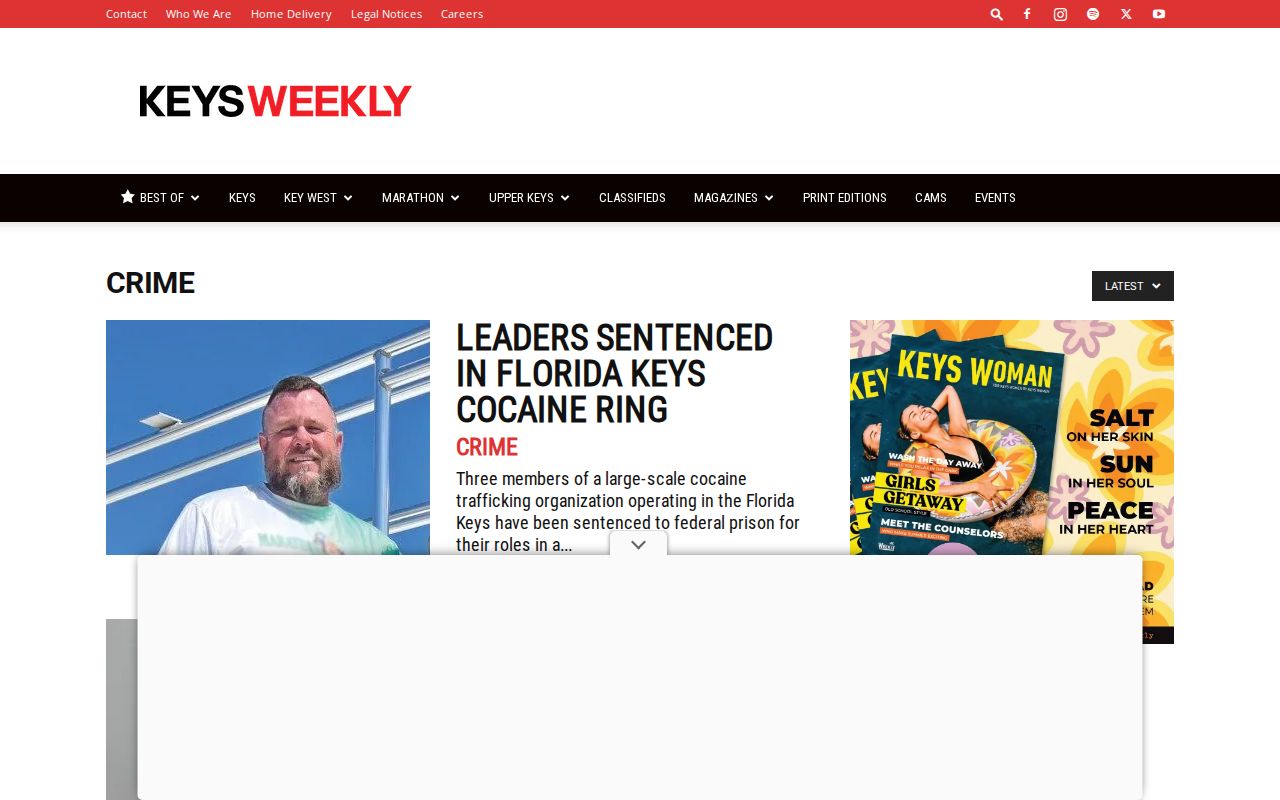
Its blend of arrest reporting and later court outcomes makes it strong context. For the record itself, MCSO and the Clerk remain the authoritative sources.
Monroe County Mugshots in News
How does a booking photo end up in the news? Three ways, mainly. An agency may release it on its own. A reporter may request it under public-record law. Or someone may supply it with an announcement. Florida's public-record framework opens agency records unless an exemption applies, but it never forces an agency to attach every photo to every arrest tool or press release.
Editorial choice adds another layer. One story may run a booking image, the next a scene photo, and a third nothing at all. Read captions closely. They tell you whether MCSO, KWPD, the State Attorney, a contributor, or the outlet itself supplied the picture.
Florida Statutes section 901.43 covers removal requests aimed at certain commercial booking-photo publishers. It does not block legitimate news reporting. It promises no deletion from official sources, and it does not turn a cached copy into a current record. Sealing and expungement run through separate FDLE and court processes.
Monroe County Story-to-Record Path
Treat any report as a starting point, not a conclusion. The path below checks the event against official sources, separates present custody from an older booking, and then follows the court case through to its result.
- Read the date, location, named agency, and charge in the story. Note whether the image caption identifies an official source.
- Check MCSO Current Arrests for the recent booking event. Its exact lookback window and photo display were not established in accessible official text.
- Use Current Inmates only if present Monroe County jail custody is the question.
- Move to Arrest Search for an older named arrest or after a roster entry is gone.
- Search the Monroe Clerk docket for filed charges, amendments, pleas, dismissals, sentence, or closure.
Freedom and closure are two different things. Someone can walk out of the Key West jail while the case stays fully open, and the article that named them may never change. Flip it around, too. A person vanishing from the current-inmate list does not mean the charge went away. News pages simply age; they do not track outcomes.
For real answers, follow the custody channel. A short stay sits with the sheriff. A longer sentence moves the person to state prison, and then the Florida Department of Corrections Offender Network is where status lives. Old headlines stop mattering at that point. The Monroe County booking and roster hub lays out each channel in plain terms.
Monroe County Arrests After Booking
Florida sets a clock on first appearances. Rule of Criminal Procedure 3.130 generally puts an arrested person in front of a judge within 24 hours unless they were already released lawfully. At that hearing the judge walks through the charge, lays out the person's rights, and takes up the question of release. Nothing is decided there on guilt.
Monroe County adds a local layer. Through the Sixteenth Circuit's Pretrial Services office, every defendant arrested in the county gets interviewed, and the office sends a release recommendation to the judge for first appearance and bond-reduction hearings. The call on bond still belongs to the bench. A news story about an arrest can run before any of that happens, and before a prosecutor has weighed in on filing.
What happens afterward lives in the docket. Clerk entries may show a charge amended, dropped, never filed, resolved through a plea, taken to trial, or simply closed out. Some local reporters track that arc. None promise to circle back on every arrest, so the court record is the place to confirm the sequence.
Monroe County Unofficial Mugshot Pages
Start with official sources before touching third-party pages. Busted Newspaper carries rolling Monroe booking cards plus a deep archive. RecentlyBooked runs a county section covering about 30 days and refreshes it multiple times daily. Those descriptions come from the publishers, not from MCSO.
Mugshots.com lets visitors filter Monroe entries by name, year, and city. Its visible year filters stop at 2021, though, making it mostly a historical trove. Arrests.org has search and archive tools but gaps in its current data. One archive stamped 2025 still returned records while its recent landing pages showed none. An empty page there is not proof the county had no bookings.
The Monroe endpoint Mugshots.zone advertises returned an error, so its fields, images, update pace, and removal process went unverified. Two other Monroe-branded sites just repackaged or linked out to official and aggregator pages. Treat them as shortcuts rather than booking sources of record.
For a sense of what a secondary site looks like in practice, the RecentlyBooked Monroe County section is a representative example.
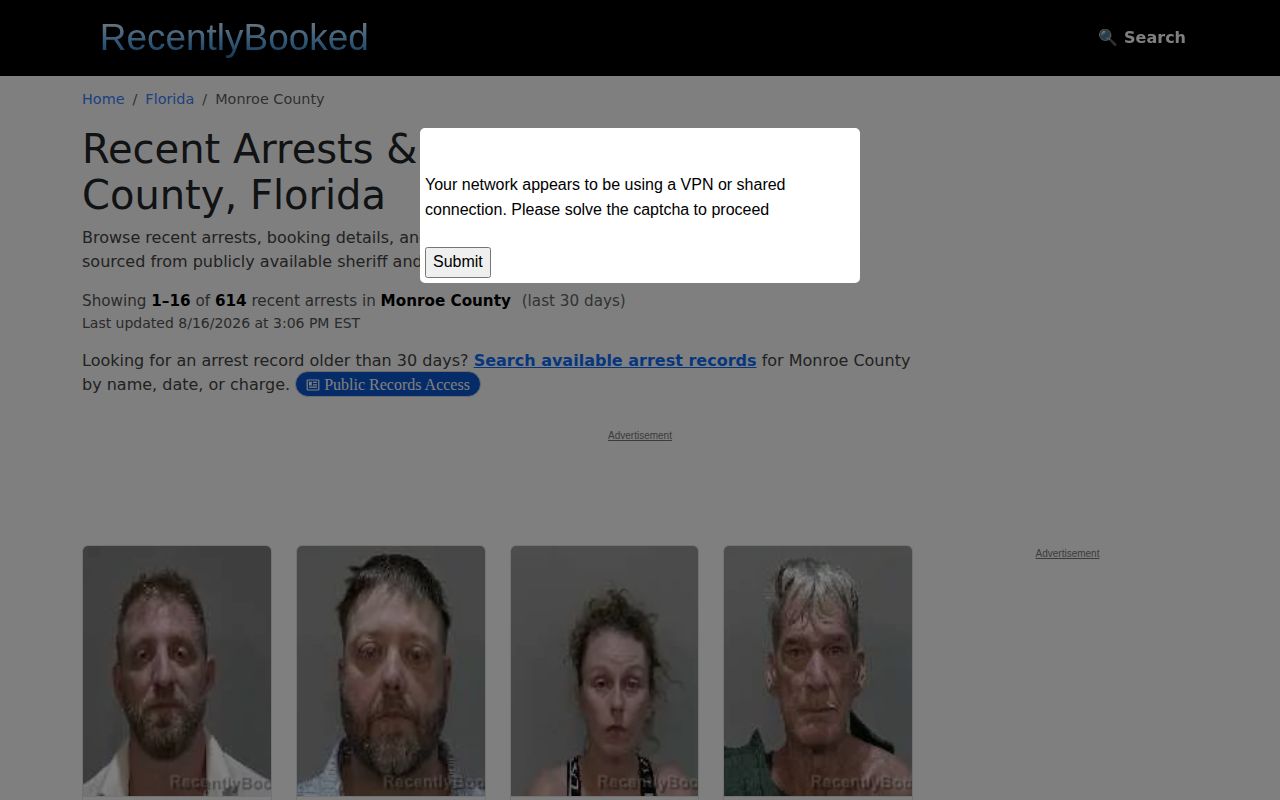
Whatever a third-party page shows, the check belongs to the official record. Booking and custody facts come from MCSO. The final court result comes from the Clerk.
Monroe County City Crime Coverage
Key West has the deepest city coverage in the county. KWPD posts selected releases. Florida Keys Weekly runs a Key West stream, and KeysNews leans closest to the city itself. The Blue Paper adds historical context but won't answer today's booking questions. Even the Key West busted mugshot path runs through MCSO, since the sheriff controls booking and detention records countywide.
Marathon and Islamorada get police service from MCSO under contract. Florida Keys Weekly covers both. Its Marathon and Middle Keys section runs alongside Islamorada and Upper Keys reporting. The sheriff's seven-day call log can surface local incidents, though it will not name anyone arrested. Countywide outlets and aggregators sometimes pick up both cities. Neither adds up to a complete municipal feed.
Note: A city tag or news vertical organizes stories but never proves a full city arrest log or current jail status.